Slot RTP and Volatility Explained Without the Jargon
 Clubs Poker Basic

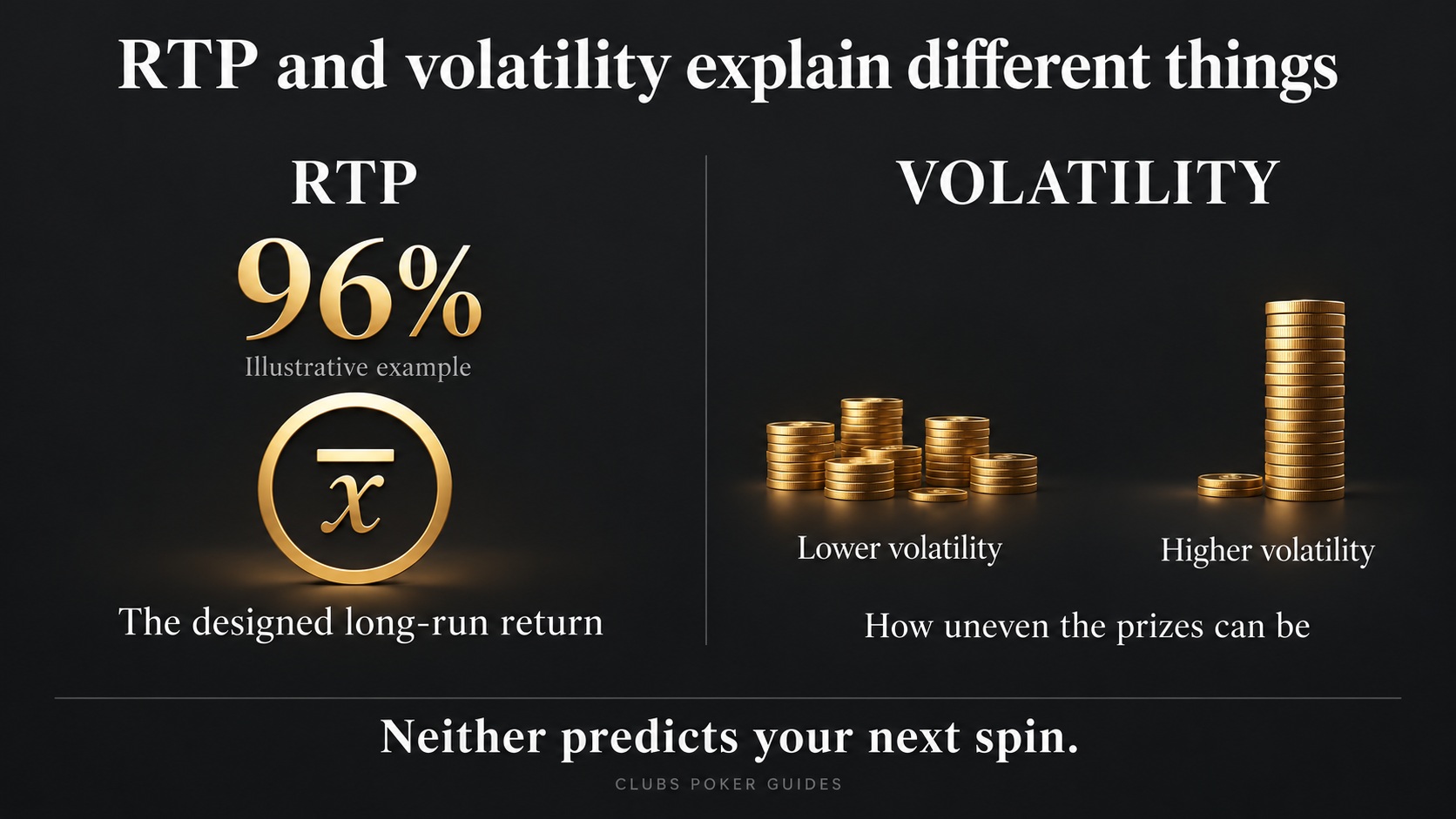
RTP tells you about a slot’s designed long-run return. Volatility describes how unevenly its prizes can arrive. They are different measures, and neither predicts what your next spin will pay.
Understanding both helps you read a game’s information without mistaking a percentage or a rating for a promise.
What does slot RTP mean
RTP stands for return to player. It is the percentage of total stakes a game is designed to return as prizes over a very large number of plays.
For a hypothetical slot with 96% RTP, the mathematical average is 96 SC returned for every 100 SC staked across a huge volume of play. That does not mean staking 100 SC in one session will give you 96 SC back. Your result can be much higher or lower.
Total stakes also include winnings played again. They are not the same as the amount you purchased or the balance you started with. The remaining 4% in this example is the theoretical house edge, not a fixed charge on each spin.
What is slot volatility
Volatility describes the spread of possible results. A lower-volatility slot typically distributes prizes in smaller, more frequent amounts. Higher volatility can involve longer gaps between meaningful payouts, with more of the return concentrated in larger prizes.
Neither style guarantees a particular session length or result. A high-volatility rating does not mean a big prize is due, and a low-volatility game can still use up your balance.
RTP volatility and hit frequency compared
| Term | What it tells you | What it cannot tell you |
|---|---|---|
| RTP | The designed long-run return | What you will receive in a session |
| Volatility | How widely prizes can vary | When a large prize will arrive |
| Hit frequency | How often a payout occurs | How often a spin produces a profit |
Can two slots with the same RTP feel different
Yes. Two games could both have a theoretical RTP of 96% but distribute their prizes very differently. One may return more through modest payouts; another may concentrate more in rarer, larger outcomes. The average alone does not describe those swings.
Hit frequency is a separate figure. It describes how often a spin pays something. A payout below your total stake is still a loss on that spin, so frequent payouts do not necessarily mean frequent profits.
Where to check RTP on Clubs Poker
Open the Clubs Poker casino lobby and use the game search to find a title. Before spinning, check its help, rules or paytable for the RTP and any volatility information the provider supplies. The location and labels vary by game.

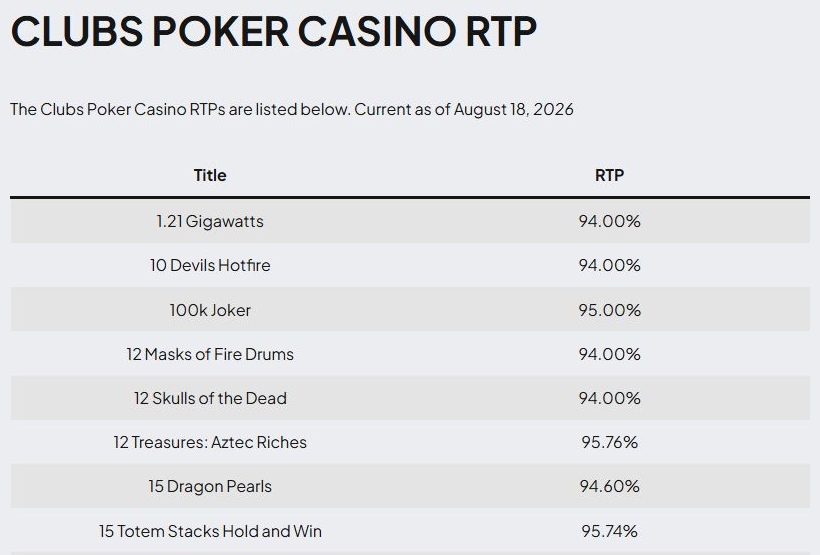
You can also consult the Clubs Poker Casino RTP list. At the time of this review, that page was labelled current as of August 18, 2026. Use the information for the version you are actually playing, rather than assuming a figure from another site applies.
Does a losing streak make a win more likely
A run of losses does not make a random slot owe you a payout. RTP is not a meter that must catch up during your session. Playing longer to reach the advertised average gives you no guaranteed recovery.
Read the rules, choose a stake within a preset budget and set a time limit. RTP and volatility help explain the game; they cannot remove its uncertainty.
Further reading: Gambling Commission guide to RTP and Playtech research on slot volatility.


Sign up and get:
30 SC Free
Available to all new players
18+. Eligibility and game rules apply. The 96% example is illustrative, not a quoted RTP for a particular Clubs Poker slot. Play responsibly.